
What Is a Good Bounce Rate for Cold Email?
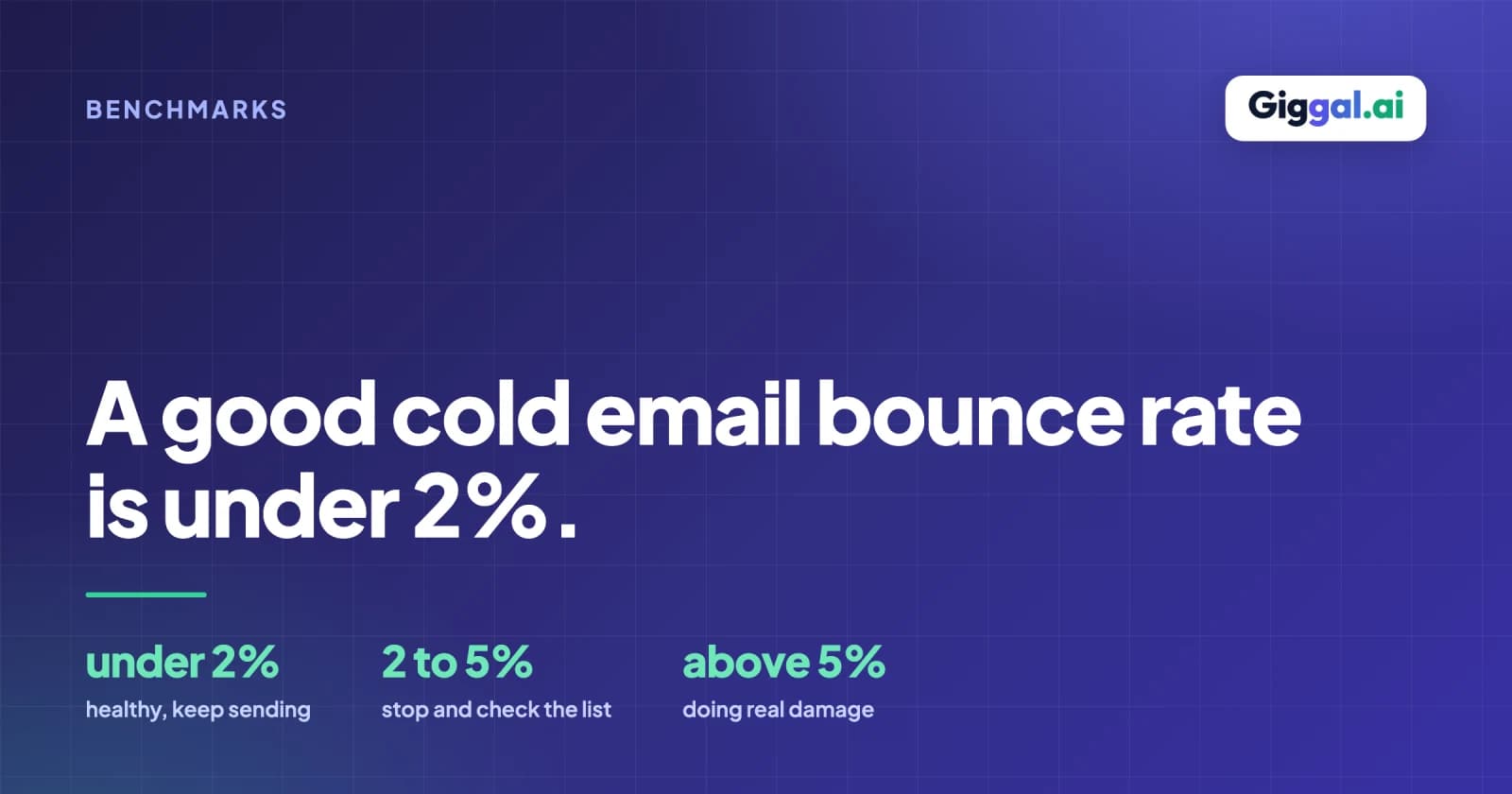
A good bounce rate for cold email is under 2 percent. If you are asking what is a good bounce rate for cold email, that is the number to aim for, and anything above 5 percent is doing active damage to your ability to reach an inbox. Between those two figures is a band that needs attention but is not yet an emergency.
The three bands and what each one means
These are the cold-email bands. For marketing and transactional mail, which are judged on tighter numbers, see the bounce rate benchmarks table.
The thresholds are easier to act on as a table than as prose.
| Bounce rate | What it signals | What to do |
|---|---|---|
| Under 2% | Healthy | Keep sending, verify every new list before its first send |
| 2 to 5% | Needs attention | Pause, check where the list came from and whether your domain is authenticated |
| Above 5% | Actively damaging | Stop, clean the whole list and fix sender setup before resuming |
Under 2 percent is the range a well-kept list stays in. It signals that your addresses are current and your sending domain is trusted. The 2 to 5 percent band is a prompt to look before you send again, because the cause is almost always fixable and gets worse if ignored. Above 5 percent, mailbox providers start treating your mail as low quality, and continuing to send makes the hole deeper.
Why the number swings around on small sends
Read the rate together with the size of the send, because on small lists the percentage moves hard. A list of 500 addresses with 15 that no longer exist is already at 3 percent, inside the attention band, on nothing more than a slightly stale list. The same 15 dead addresses in a list of 5,000 read as 0.3 percent and pass without notice.
So a high percentage on a few hundred recipients can be one afternoon of bad data rather than a real problem. The same figure on a large, warmed list is worth stopping for. The number alone is not enough; the volume behind it changes what it means.
Why cold email is held to a stricter standard
Opt-in marketing lists get more room. The people on them asked to be there, engagement is higher, and providers read that engagement as a sign you are wanted. Cold email has none of that history. Every recipient is someone the provider has no reason to believe wanted your message, so the same bounce rate that passes quietly on a newsletter reads as a warning sign on a cold campaign. You are judged harder because you start with less trust.
Google and Yahoo changed the stakes
In early 2024 Google and Yahoo introduced bulk sender requirements that turned this from a soft guideline into something with teeth. Senders above a daily volume now have to authenticate their mail with SPF, DKIM and DMARC, make unsubscribing simple, and keep spam complaints below a set threshold. Google put that spam complaint rate at 0.3 percent.
Bounces feed into the same picture of sender quality that these rules police. A list that bounces heavily now risks more than a few lost messages. It can affect whether your mail is accepted at all, which raises the cost of sending to a list you have not checked.
A bounce is not the same as landing in spam
It helps to separate two numbers people often blur together. A bounce is a message the server refused outright, and it is the one that feeds your bounce rate. Landing in the spam folder is different; the message was accepted and delivered, just filed where nobody looks. A campaign can post a clean bounce rate and still fail, because most of it sat in spam. So read the bounce rate as a measure of list quality, not of whether people saw your mail. The two problems have different fixes, and treating a low bounce rate as proof of success is a common and costly mistake.
How to find your own bounce rate
Whatever you send with reports this number. In most sending and cold-outreach tools it appears on the campaign summary as a bounce percentage, calculated as bounced messages divided by messages sent. If your tool separates hard and soft bounces, look at the hard bounce figure first, because that is the one tied to list quality. If it only shows a combined number, treat a sudden jump as a reason to stop and look before your next send.
Check the first send of a new list separately from your running average. A fresh, unverified list shows its true bounce rate on that first campaign, before the dead addresses have been pulled out, and that is the number that tells you whether the list was any good. Your ongoing average across warmed, cleaned lists always looks better and can hide a bad import until it does damage.
What to do at each level
Under 2 percent, keep doing what you are doing, and verify any list you buy or import before its first send so it stays there. In the 2 to 5 percent band, stop adding to the problem, check where the list came from, and confirm your authentication records are in place; the causes are usually the list or the setup, and why cold emails bounce breaks down the specific ones.
Above 5 percent, stop sending entirely. Run email list cleaning on the whole list, fix any domain issues, and resume slowly once the numbers recover. A verified list is the fastest way back under the line, and you can verify catch-all & risky emails as part of that cleanup so the addresses most tools give a cautious label to are resolved rather than dropped.