
How to End an Email: Sign-Offs, Closing Lines and Examples
Most people get stuck on the last two words of an email. Should it be "Best"? "Kind regards"? "Thanks"?
Here's the short answer. A good email ending has three parts: a clear closing line, a sign-off that fits the situation, and your name. If you're asking for something, end with "Thanks". If you're not, "Kind regards" or "Best regards" fits most work emails.
Could you send the signed contract by Friday?

Thanks,
Priya
The rest of this post explains why, with the research behind it. It covers the email endings that suit each situation, the punctuation rules, endings in other languages, and the email sign-offs people dislike most.
The three parts of an email ending
An email ending has three separate parts, and each one has a different job.
- The closing line is a full sentence. It tells the reader what happens next, such as "Could you confirm by Thursday?"
- The sign-off is the short farewell before your name, such as "Thanks," or "Kind regards,".
- Your name and signature come last. In a first email, add your role and company. In a quick reply, your first name is enough.
Keep the signature short. The old internet etiquette guide, RFC 1855, suggested no more than 4 lines, and that still works. If you want a clean, consistent one, the email signature generator builds it for Gmail, Outlook and Apple Mail.
Email endings for work: the common sign-offs
These are the sign-offs you'll see most in work email, roughly from most formal to most casual.
| Sign-off | Tone | When it fits |
|---|---|---|
| Sincerely | Formal | Cover letters, formal letters, first contact with someone senior |
| Kind regards | Polite, standard | Most work emails |
| Best regards | Polite, standard | Most work emails |
| Regards | Neutral | Short work emails, complaints, people you don't know |
| Thank you | Polite | When someone has helped, or you're asking for help |
| Thanks | Friendly | Requests, quick replies, colleagues |
| Best | Friendly | Colleagues and contacts you write to often |
| Best wishes | Warm | People you know a little, social or friendly notes |
| Have a great weekend | Warm | Friday emails to people you know |
| Cheers | Casual | Colleagues you know well, never in a complaint |
Formal email endings like "Sincerely" and "Kind regards" are a safe choice in a first email. You can relax the tone once the other person does. When learners on the British Council's business English course asked how formal to be, a member of its team answered that, in general, it's better to be more formal.
What the research says about sign-offs
Most advice on email endings is opinion. A few studies and surveys add real numbers, and they point the same way more often than you'd expect.
Sign-offs with "thanks" got the most replies
In 2017, Boomerang looked at the closings in over 350,000 email threads from the mailing lists of online communities. It counted how often each email got a reply:
| Sign-off | Reply rate |
|---|---|
| Thanks in advance | 65.7% |
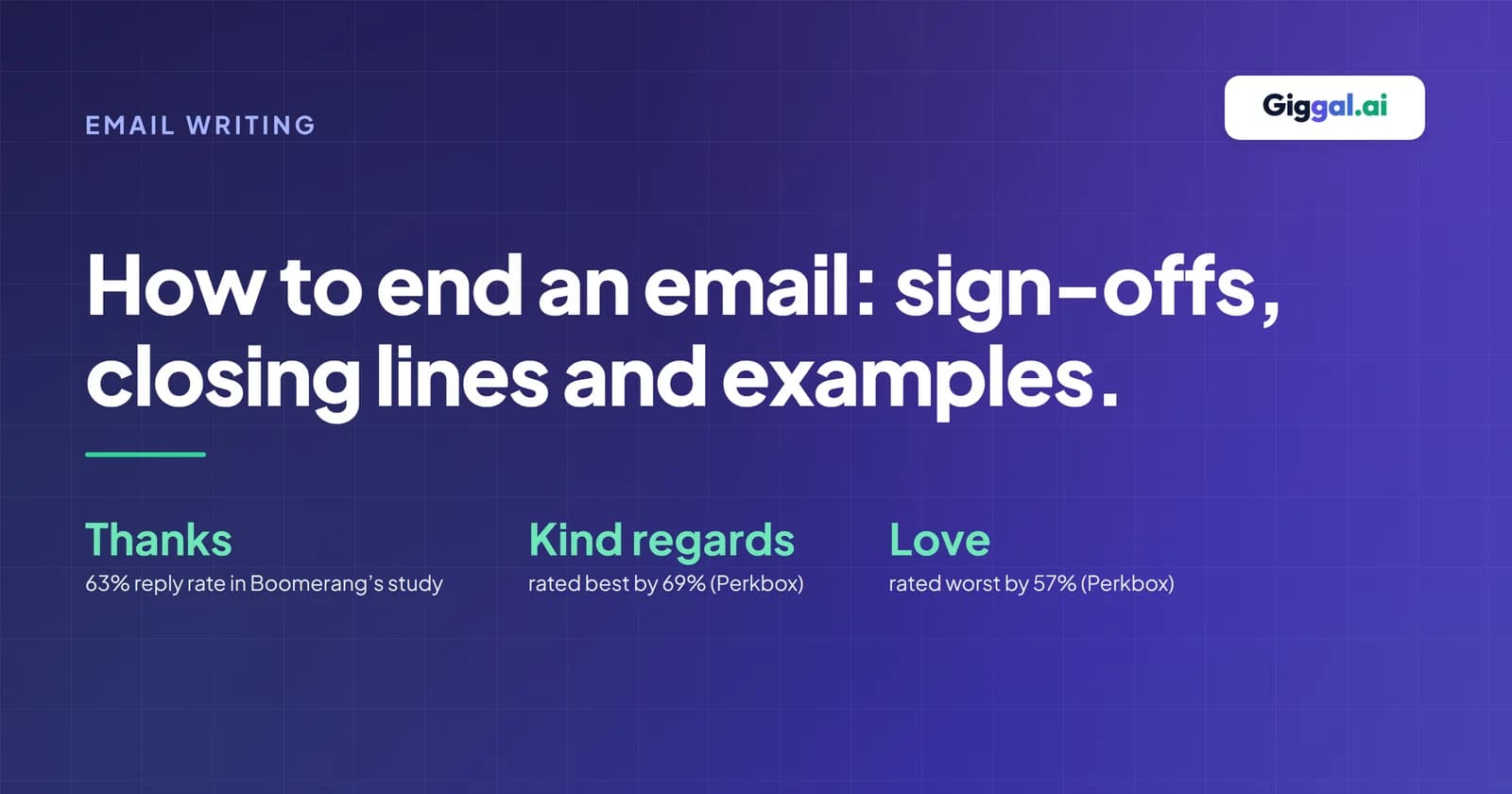
| Thanks | 63.0% |
| Thank you | 57.9% |
| Cheers | 54.4% |
| Kind regards | 53.9% |
| Regards | 53.5% |
| Best regards | 52.9% |
| Best | 51.2% |
| All emails | 47.5% |
Closings with some form of thanks got replies 62% of the time, against 46% for the others. Keep the limits in mind, though. These were mailing lists between strangers, not business email. The study shows a link, not a cause, and Boomerang itself says it couldn't control for the relationship between sender and reader.
What people say they like and dislike
Surveys ask a different question: what people prefer, not what gets answered.
- In a Perkbox survey of 1,928 people, 69% picked "Kind regards" as one of the best sign-offs, followed by "Thanks" at 46%. "Love" was the most disliked at 57%, and 44% disliked emails with no sign-off at all.
- A YouGov poll for HuffPost of 1,000 US adults found "Thanks" was the most used sign-off, at 62%. The most annoying ending was no sign-off, at 41%, followed by "xoxo" at 24%.
- A Preply survey of 1,005 Americans found "Thank you" (38%) and "Thanks" (30%) were the most preferred.
Put together, the pattern is clear. Gratitude and plain politeness do well. Overly familiar endings and no ending at all do badly.
The "thanks in advance" question
"Thanks in advance" is the one sign-off the sources disagree on. It had the highest reply rate in Boomerang's data, and 21% of Perkbox respondents rated it among the best. But only 5% of Preply's respondents preferred it, and some writing guides call it presumptuous, because it assumes the answer is yes.
Alison Green of Ask a Manager offers a sensible rule. She says "thanks in advance" is fine most of the time. It reads badly only when you're asking a real favour the person could reasonably refuse. In that case, something like "I'd be so grateful if you're able to make it work" fits better.
How to end an email that requires a response
If you need an answer, the closing line does most of the work. The sign-off only sets the tone.
Make the ask specific. Say what you need, and by when. A vague ending like "Let me know your thoughts" leaves the reader to work out what you want.
Does Tuesday at 2pm work for a 20-minute call? If not, send me two times that suit you.

Thanks,
Daniel
Could you approve the budget by end of day Thursday? We need it to book the venue.
Thank you,
MiaQuestions help in general. In another Boomerang analysis of over 40 million emails, emails that asked 1 to 3 questions were 50% more likely to get a response than emails with none. That study looked at questions anywhere in the email, not only at the end. Still, the last line is the natural place for your main one.
Pair a clear question with a thank-you sign-off. Based on the reply rates above, "Thanks" is a good default for any email that asks for something.
Email ending examples by situation
Job applications and cover letters
Use "Sincerely" and your full name. University career centres still recommend it. Indiana University's guide, for example, says to thank the employer for their time and close with "Sincerely" and your typed full name.
Thank you for your time and consideration. I'd welcome the chance to discuss how I could help the team.

Sincerely,
Jordan Lee
jordan.lee@example.com
Some sites call "Sincerely" outdated. The research doesn't back that up for formal letters. If it feels stiff in a short follow-up email, "Kind regards" works too.
Emails to a professor or teacher
Keep it formal and give enough detail to identify you. The University of Kansas Writing Center suggests closings like "Thank you," "Best regards," or "Sincerely," and you can add your class to the signature.
Thank you for your help.

Best regards,
Sam Patel
ECON 201, Section 3
Cold emails and sales outreach
There's no reliable data on which sign-off works best in cold email. Keep it simple: a short closing line that makes it easy to say no, then "Thanks" and your first name. Our cold email templates all end this way, so you can see it in context.
Complaints
Avoid warm endings. Purdue OWL warns that "Best Wishes" or "Cheers" can weaken a complaint, because they suggest a closeness that doesn't fit. "Regards" or "Thank you" keeps the tone firm and polite.
Internal emails and quick replies
Inside a team, you can relax a lot. Ask a Manager notes that it's very normal to end internal emails with "Thanks" or just your name. In a fast back-and-forth, many people drop the sign-off altogether. One study of workplace email in New Zealand found that the culture of the workplace shaped how people closed emails more than rank or gender did. So follow what your colleagues do.
Thank-you emails
The thanks is the point of the email, so say it in the closing line and keep the sign-off plain.
Thanks again for taking the time to walk me through the process. It made the decision much easier.

Best regards,
Elena
Punctuation and capitalization
- Put a comma after the sign-off, then start your name on a new line. The British Council teaches it this way.
- Capitalize only the first word. Write "Kind regards," and "Best wishes," not "Kind Regards,". Linguist Larry Trask states the rule plainly: only the first word of the closing is capitalized.
- No comma is fine too, in some styles. Some UK businesses use open punctuation, with no comma after the greeting or the sign-off. Pick one style and use it every time.
- Other languages have their own rules. German, for example, uses no comma at all after the closing, according to Duden.
Email endings in other languages and in British English
If you write to people abroad, use the ending they'd use. These are the standard ones, from sources in each language:
| Language | Formal | Less formal |
|---|---|---|
| British English | Yours sincerely (to a named person), Yours faithfully (to "Dear Sir or Madam") | Kind regards, Best wishes |
| American English | Sincerely | Best, Thanks |
| German | Mit freundlichen Grüßen | Freundliche Grüße, Beste Grüße |
| French | Cordialement | Bien à vous |
For British letters, Trask gives the rule: "Yours sincerely" for a named person, and "Yours faithfully" after "Dear Sir or Madam". He adds that the distinction doesn't matter much. In German, "Liebe Grüße" is only for private messages. In French, Cordialement is the one used most in email, while the long "Veuillez agréer" formulas belong in formal letters.
Sign-offs and endings to avoid
- "Love" and "xoxo". "Love" was the most disliked sign-off in the Perkbox survey, at 57%. Keep both for family and friends.
- No sign-off in a first email. 44% of Perkbox respondents disliked it. Purdue OWL's advice is to type at least a closing like "Best," and your name.
- "Cheers" and "Warmly" with people you don't know. In the Perkbox survey, 26% rated "Cheers" one of the worst, and 31% said the same of "Warmly".
- Abbreviations like "Rgds". The British Council lists "Rgds" as informal only, so keep it out of anything formal.
- Smiley faces in a first work email. In three experiments, smileys made the sender seem less competent and did not make them seem any warmer.
- Passive-aggressive closing lines. "As per my last email" annoyed 33% of Perkbox respondents, and "Please advise" annoyed 8%.
"Sent from my iPhone" is a mixed case. In the Preply survey, 51% wanted people to stop using it. But a 2012 study found that a mobile signature softened how harshly readers judged typos. If you mostly email from a computer, turn it off. On a phone, it may even help readers forgive a typo.
Do you always need a sign-off?
In a first email to someone, yes. A missing sign-off reads as abrupt to many people, and the surveys above put it among the most disliked endings.
Once a conversation is going, you can drop it. In a quick reply chain with a colleague, your name or nothing at all is normal. Not everyone loves sign-offs either. A Slate essay argued for dropping them entirely. Still, keep one in anything that isn't a fast back-and-forth.
Before you hit send
A good ending can't help an email that never arrives. If you're emailing a new contact or a whole list, check that the address works first. The email checker verifies a single address, and the bulk email verifier checks a full list, so your carefully worded sign-off reaches a real inbox.
Frequently asked questions
What is the best way to end an email?
End with a clear closing line, a sign-off and your name. "Thanks" works best when you're asking for something, and in Boomerang's data, sign-offs with thanks got the most replies. "Kind regards" or "Best regards" suits most other work emails.
How do you end an email professionally?
Finish with a sentence that says what happens next. Then add a polite sign-off like "Kind regards," "Best regards," or "Thank you," and your full name and role. For cover letters and formal letters, use "Sincerely".
Is "Regards" rude?
No. It's neutral and short, which suits brief work emails and complaints. In the Perkbox survey, 31% of people rated "Regards" one of the best sign-offs. "Kind regards" sounds a little warmer if you're unsure.
Should "Kind regards" be capitalized?
Capitalize only the first word: "Kind regards,". The same goes for "Best regards," and "Best wishes,".
Is "Thanks in advance" rude?
Usually not. It had the highest reply rate in Boomerang's study, and Ask a Manager calls it fine most of the time. Avoid it when you're asking a real favour the person might want to refuse.
What can I use instead of "Sincerely"?
"Kind regards," "Best regards," and "Thank you" are the usual alternatives in email. Keep "Sincerely" for cover letters and formal letters.
Do you put a comma after the sign-off?
In English, yes, in most styles: "Thanks," then your name on the next line. Some UK writers leave the comma out. German leaves it out as a rule.