

Linux Kernel TCP Vulnerability (CVE-2026-98432): What to Do
CVE-2026-98432 is a critical bug in the Linux kernel's TCP code. It lets an attacker on the internet make the kernel read memory it has already freed. Anthropic reported an exploit that used it to run commands as root, with no password. The bug has been in Linux since version 4.4, released in 2016.
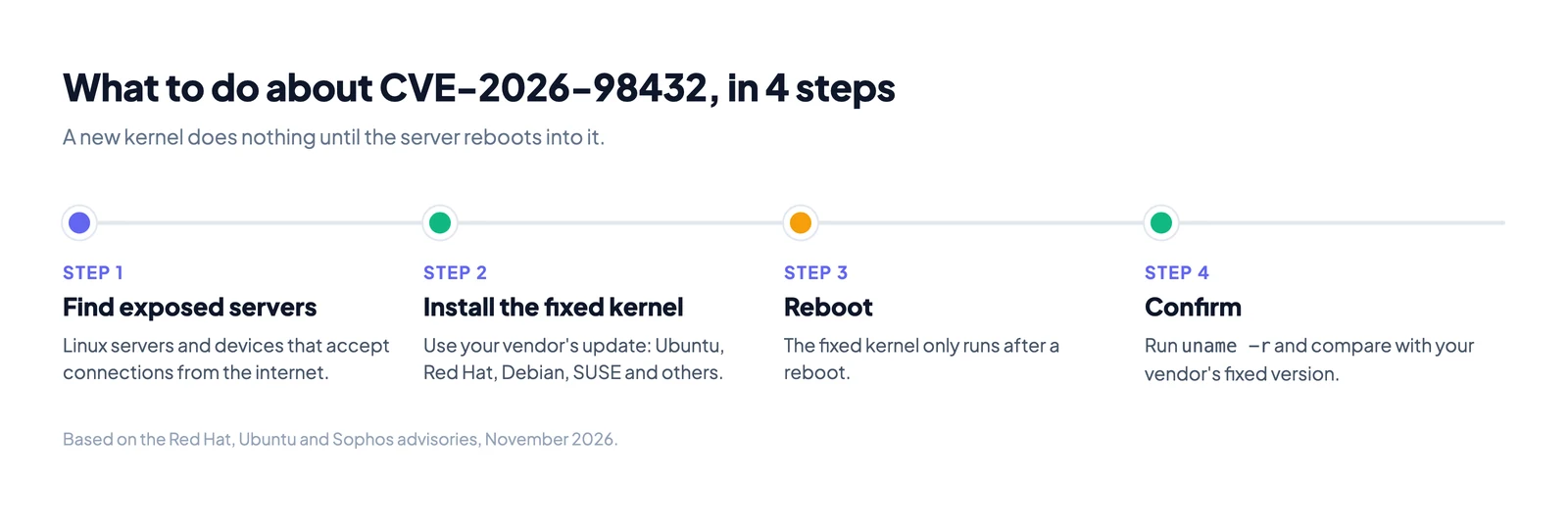
The fix is a new kernel and a reboot. Ubuntu, Red Hat, Debian, SUSE, Oracle and Amazon have all shipped fixed kernels for at least some of their releases. A kernel update does nothing until the server reboots into it.
What CVE-2026-98432 is, in plain English
The kernel is the core of Linux. It runs the network, the disks and the memory for every program on the machine. TCP is the part of the network code that opens and runs connections. Web servers, mail servers and SSH all use TCP.
This bug is in the IPv4 TCP code. So almost every Linux server that accepts connections is in scope. That includes cloud servers, home routers, firewalls and other devices built on Linux. IPv6 is not affected by the main bug.
The Linux kernel's own CVE team rated it 9.8 out of 10 (CVSS 3.1). That is the "critical" band. It needs no login and no action from a user.
How the bug works, step by step
You need three facts about how a TCP connection starts.
- A client sends a SYN packet. It means "I want to connect."
- The server answers with a SYN-ACK. It means "OK, go ahead."
- The client sends an ACK. The connection is now open.
A SYN packet can carry extra fields called IP options. Two examples are Record Route and Timestamp. Very few normal programs use them today.
Here is what goes wrong.
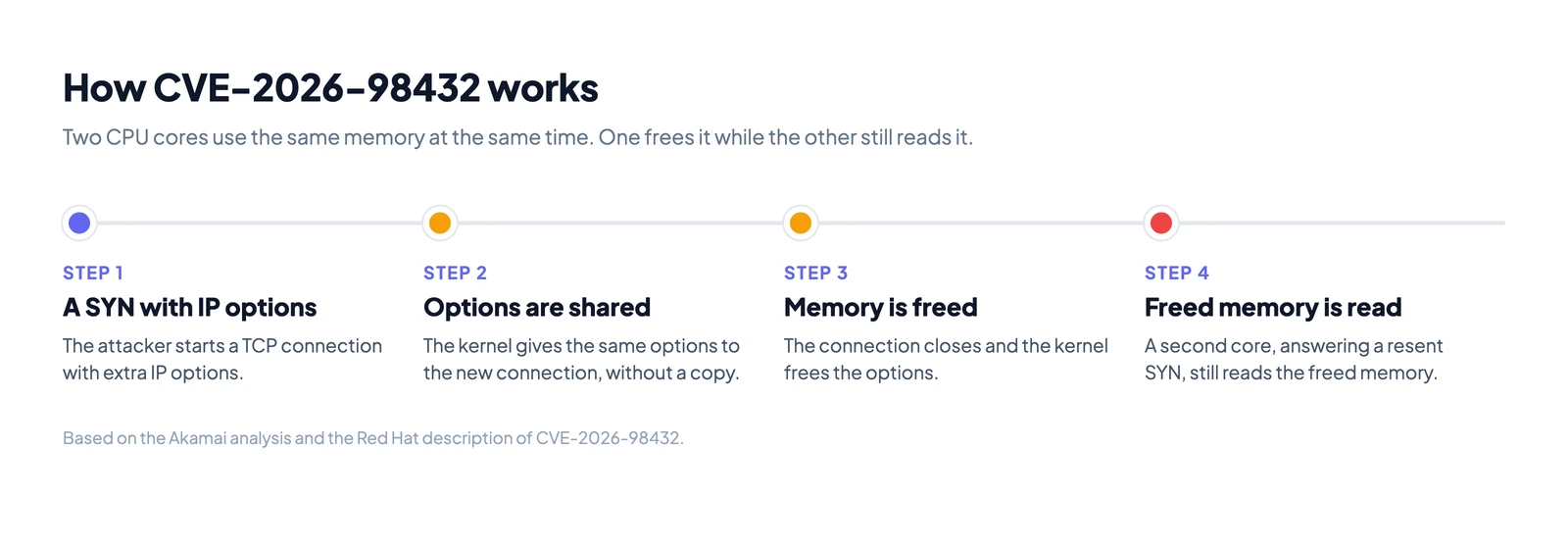
- The attacker sends a SYN that carries IP options.
- The kernel stores those options with the half-open connection. It uses them to build its SYN-ACK reply.
- The connection completes. The kernel hands the same stored options to the new, open connection. It does not make a copy.
- At the same moment, the attacker resends the first SYN. Another CPU core starts to build a second SYN-ACK from the same options.
- The new connection closes, and the kernel frees its memory, including the options.
- The second core is still reading the options. It now reads memory that has been freed and may hold something else.
Programmers call this a "use after free" bug. It is also a race: two CPU cores act on the same memory at the same time. Since Linux 4.4, the kernel handles half-open connections without a lock that would stop this. That is why the bug is that old.
If the attacker loses the race, the connection simply fails. They can try again as many times as they want.
The fix
Eric Dumazet wrote the fix. The kernel now waits until no other CPU core can still be reading the options before it frees them. The fix went into the kernel on 5 October 2026.
Where Multipath TCP fits in
Multipath TCP (MPTCP) lets one connection use several network paths at once. Anthropic's exploit needs a server with an MPTCP listener.
That does not mean you are safe without MPTCP. The Go security team says the bug is not specific to MPTCP. Red Hat ships MPTCP turned off by default and still says default RHEL systems are affected.
One detail matters for many teams. The Go security team says Go 1.24 and newer turn on MPTCP for listening sockets on Linux by default. So a server running a Go program can have an MPTCP listener without anyone choosing it.
How it was found
An Anthropic researcher reported the bug. On 27 October 2026, Anthropic said a Claude model wrote a working exploit for it after initial prompting.
Anthropic described two stages. First, the exploit won the race to leak a kernel memory address. This took 48 minutes in its test. Then it overwrote a pointer in the kernel and ran a chosen command as root. This took 5 more minutes. Anthropic has not published the exploit code.
Is anyone using it in real attacks?
Not that anyone has confirmed. On 6 November, Sophos said it knew of no attacks in the wild. The bug was not in CISA's Known Exploited Vulnerabilities (KEV) catalog as of version 2026.11.10.
That can change fast. The details of the bug are public, and a working exploit is known to exist. Patch now instead of waiting for the first attack report.
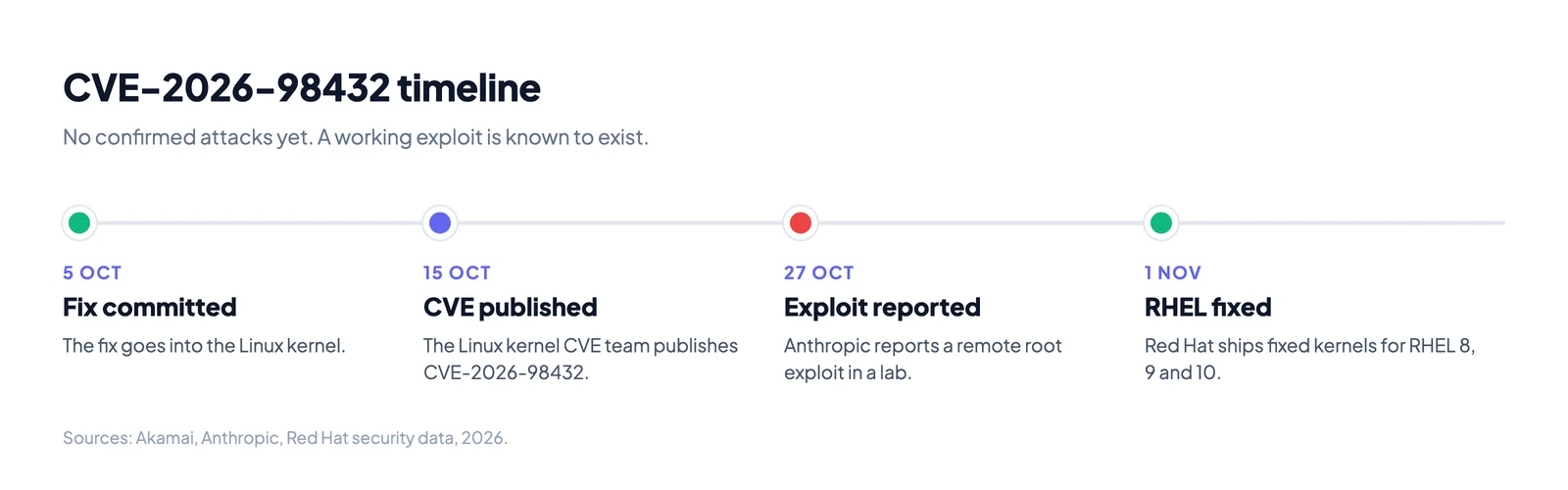
| Date (2026) | What happened |
|---|---|
| 5 October | Fix committed to the Linux kernel |
| 15 October | Linux kernel CVE team publishes CVE-2026-98432 |
| 16 to 22 October | Oracle and Debian ship fixed kernels |
| 27 October | Anthropic reports a remote root exploit |
| 29 October | Go security team warns about MPTCP being on by default |
| 1 November | Red Hat ships fixed kernels for RHEL 8, 9 and 10 |
What an attacker can do with it
The kernel controls everything on the machine. So a working attack on the kernel is worse than an attack on one app.
| What the attacker can do | What it means for you |
|---|---|
| Run commands as root | Anthropic showed this in a lab, against a server with an MPTCP listener. Root can read and change every file. |
| Read kernel memory | The first stage of the exploit leaks kernel data. This helps the attacker defeat the kernel's memory protections. |
| Crash the server | Red Hat lists a crash as one possible result. A crashed server takes every site and service on it offline. |
| Plant a backdoor | With root, an attacker can install hidden access that survives a patch. |
| Use your server to send spam | A taken-over server can send spam and phishing from your IP and domain. Then your real email lands on blacklists. |
Who is affected
Any Linux system with a kernel from version 4.4 onward that does not have the fix. The upstream fix is in these kernels:
| Kernel branch | Fixed in |
|---|---|
| 7.3 | 7.3 (all releases) |
| 7.2 | 7.2.10 |
| 6.18 | 6.18.56 |
| 6.12 | 6.12.113 |
| 6.6 | 6.6.159 |
| 6.1 | 6.1.190 |
| 5.15 | 5.15.223 |
| 5.10 | 5.10.272 |
Older branches that no longer get updates, from 4.4 up, stay vulnerable.
Your distribution uses its own numbers. Ubuntu and Red Hat add the fix to their own kernel builds. So compare your kernel with your vendor's notice, not with the table above.
Which distributions have a fix
This is the status on each vendor's own tracker on 12 November 2026.
| System | Status | Fixed kernel |
|---|---|---|
| Ubuntu 26.10 | Fixed | 7.3.0-10.10 |
| Ubuntu 26.04 LTS | Fixed | 7.0.0-43.43 |
| Ubuntu 24.04 LTS | Fixed | 6.8.0-149.149 |
| Ubuntu 22.04 LTS | Fixed | 5.15.0-203.213 |
| Ubuntu 20.04, 18.04, 16.04 | Fix in progress | not yet released |
| RHEL 10 | Fixed (RHSA-2026:93413) | 6.12.0-211.72.1.el10_2 |
| RHEL 9 | Fixed (RHSA-2026:93412) | 5.14.0-687.64.1.el9_8 |
| RHEL 8 | Fixed (RHSA-2026:93414) | 4.18.0-553.182.1.el8_10 |
| RHEL 7 and 6 | Not affected | none needed |
| Debian 13 (trixie) | Fixed (DSA-6568-1) | from trixie-security |
| Debian 12 (bookworm) | Fixed (DLA-4841-1, DLA-4850-1) | 6.1.190-1, or the linux-6.12 package |
Ubuntu's cloud kernels, such as linux-aws and linux-azure, have their own status lines on the same tracker. Check the one you run.
SUSE, Oracle Linux and Amazon Linux have shipped fixes for some of their kernels. Check their security pages for your exact release. AlmaLinux and Rocky Linux rebuild Red Hat's kernels, so look for their matching advisories.
Firewalls and appliances. Many network devices run Linux inside. Sophos, for example, released hotfix HF110626.1 for Sophos Firewall on 6 November. Ask the vendor of every Linux-based device you own whether it is affected.
How to patch
The fix is a new kernel, then a reboot.
Ubuntu or Debian.
sudo apt update
sudo apt full-upgrade
sudo reboot
Red Hat, AlmaLinux or Rocky Linux.
sudo dnf upgrade kernel
sudo reboot
After the reboot, check the running kernel:
uname -rCompare the result with your vendor's fixed version. To confirm the fix is inside, search the kernel package changelog for the CVE number:
# Red Hat, AlmaLinux, Rocky Linux
rpm -q --changelog kernel | grep CVE-2026-98432
On Ubuntu, a kernel at or above the fixed version in the table is enough.
Containers. A container uses the host's kernel. Updating the container image does not fix this bug. Update and reboot the host.
Cloud servers. Your cloud provider runs the physical machines. Your own virtual servers run their own kernel. You must update and reboot them yourself.
If you cannot reboot today
Red Hat and Ubuntu both describe a temporary firewall rule. It drops incoming IPv4 TCP packets that carry IP options, which the attack needs. A rule based on Red Hat's bulletin looks like this:
sudo nft add table ip cve_2026_98432
sudo nft add chain ip cve_2026_98432 prerouting '{ type filter hook prerouting priority -300; }'
sudo nft add rule ip cve_2026_98432 prerouting ip protocol tcp ip hdrlength '> 5' drop
Know its limits before you rely on it:
- It reduces the risk. It does not remove the bug.
- It can break the rare programs that use IPv4 options.
- It is lost on reboot unless you save it. Red Hat's bulletin RHSB-2026-016 shows how.
- On Kubernetes and OpenShift, a rule on the node does not filter traffic between pods.
Turning off MPTCP is not enough. Red Hat, Akamai and Sophos all say this. It blocks the path Anthropic used, but the bug stays reachable. If you still want it off, run sysctl -w net.mptcp.enabled=0. For one Go program, set GODEBUG=multipathtcp=0.
To see if anything on a server listens with MPTCP, run ss -lMn.
Watch for signs of a break-in
There are no confirmed attacks yet. Still, a root attack leaves few traces, so watch exposed servers for:
- New user accounts or SSH keys you did not add.
- Services or scheduled jobs you do not recognise.
- Server crashes or reboots you cannot explain.
- A sudden rise in outgoing email or network traffic.
- Bounces that say your IP or domain is on a blacklist.
A hacked server is often used to send spam. That can get your domain blacklisted, and then your real emails stop arriving. Our guide on how to check if your email domain is blacklisted shows how to check and fix a listing.
If you find signs of a break-in, a new kernel is not enough. Rebuild the server from a clean image or bring in an incident response team.
Quick answers
| Question | Answer |
|---|---|
| What is CVE-2026-98432? | A use-after-free bug in the Linux kernel's IPv4 TCP code that can let a remote attacker run code as root. |
| How severe is it? | 9.8 out of 10 from the Linux kernel CVE team. Red Hat and Ubuntu also rate it critical. |
| Does it need a login? | No. The attacker only sends network packets. |
| Is it used in attacks? | No confirmed attacks as of 12 November 2026. It is not in the CISA KEV catalog. |
| Does IPv6 protect me? | IPv6 traffic is not affected, but the server is still exposed over IPv4. |
| Is turning off MPTCP enough? | No. Install the fixed kernel and reboot. |
| Do I need to reboot? | Yes. The new kernel only runs after a reboot. |
Sources
- Ubuntu: CVE-2026-98432
- Red Hat: CVE-2026-98432 and bulletin RHSB-2026-016
- Debian security tracker: CVE-2026-98432
- Akamai: A remote use-after-free in the Linux kernel's TCP stack
- Anthropic: Discovering vulnerabilities with Claude
- Sophos advisory: Linux kernel TCP vulnerability
- CISA Known Exploited Vulnerabilities catalog